Component 3

Small water storages in the central region in Mozambique (component 3)

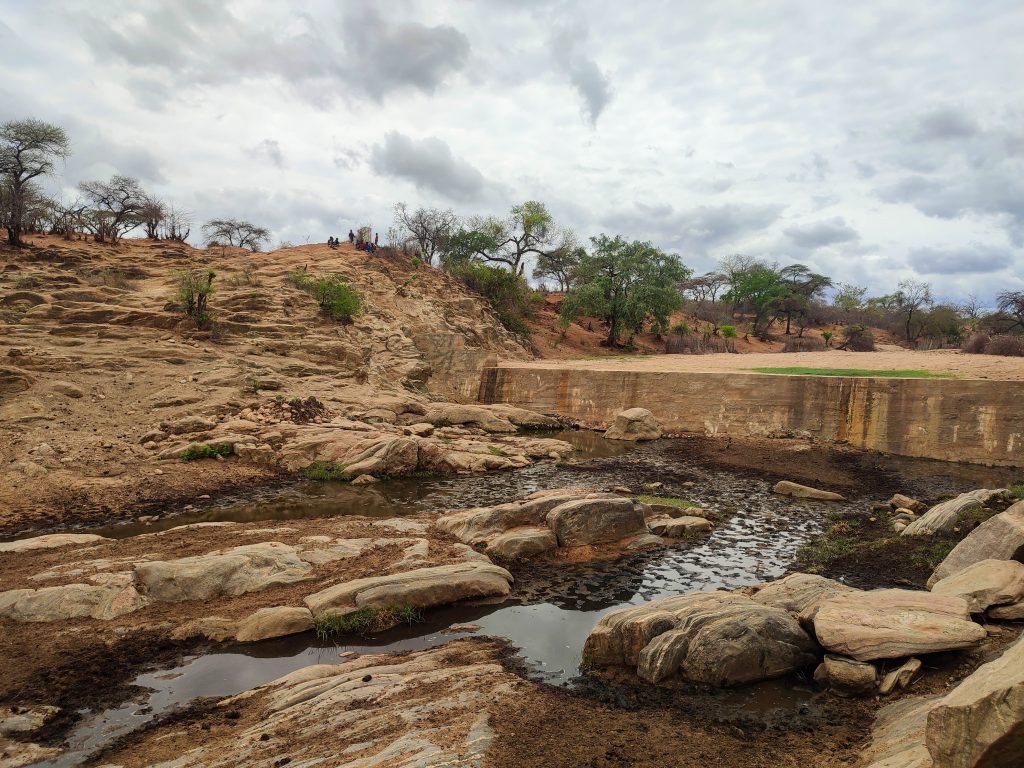
As part of the water allocation (Component 3), aiming to contribute to the improvement and innovation of the selection, construction and maintenance of small water reservoirs, a fieldwork mission took place in June 2021 in Manica and Sofala Provinces within the Pungue and Buzi basins. Two technicians of ARA Centro, a consultant from Resilience, a program partner and the program officer were part of the mission.

During the 5 days of fieldwork local government offices, agricultural fields and hydraulic infrastructure were visited to understand different water storage solutions in the region. The results of the field mission served as input for the E-learning module 4 being prepared under the cooperation of the Blue Deal with the Orange Knowledge Program (OKP).

Module 4 is a knowledge-sharing activity on water storage techniques and structures to increase water availability which will target ARA Centro technical staff and staff of NGOs involved in the process of operation and maintenance of water storage structures in order to draw up a water allocation plan for 2 pilot areas located in the districts of Nhamatanda and Vanduzi in the Pungue and Buzi basins.

Share this article

Licensing and billing of water users (component 3)

In 2021, we continued the activities to introduce the software tool SIRHA of iCarto for licencing and billing of water users within the ARAs. Amongst others, the monthly “debate group" meetings were continued

ARA Sul has used this tool since 2019 and the efficiency of the working process for licensing and billing increased dramatically. As a result, ARA Sul now has a better view of the total water use, and the revenues from water users increased. Now, fewer errors in data exist and less time is spent on the process. The video in this link https://youtu.be/AI8qQSWp84c explains these improvements.

In 2020/2021, the former five ARA’s merged into three ARA’s. In addition, the department structure changed. Now the SIRHA tool has to be adapted to this new situation and the databases of water users have to be joined. More training in the use of SIRHA will be organised for ARA Centro and ARA Norte. For this work, a new assignment for iCarto for the coming year will be prepared.

Last year a prototype was developed to integrate the data of water users in the SIRHA tool with the water allocation model (WEAP) to facilitate the hydrological assessment of new requests for water use.

ARA Sul has to send 1000-1500 bills to water users every month. To improve the efficiency of this process, a prototype was made for the integration of the SIRHA data with the billing software Primavera. In the coming year, these two prototypes will be used in the working processes of ARA Sul and will be evaluated. A new pilot will be started in ARA Sul to use satellite images to find water users and a test will be done with e-learning course online requests for a licence by new water users. After a positive evaluation of these new tools, we intend to introduce these new tools in the other two ARAs.

Under the first objective of the water allocation component, aiming to improve the process of licensing and billing, a term of reference was developed by Blue Deal with the input of all the ARA’s for the continuation of the work performed by iCarto for the development and operation of SIRHA. On May 28, 2021, the last monthly meeting of the Debate Group moderated by Anton Amado took place via Skype, where new priorities were defined by each ARA for the continuation of the partnership with iCarto. The following 4 priorities were defined: tasks for unification and restructuring, training, follow-up, support and debate, identified improvements in the system and prototype developments.

Share this article

New insights about the depletion of the groundwater system

In November 2019 ARA Sul discovered remarkable groundwater fluctuations in the Maputo - Incomanti River Basin. The data may indicate depletion of the groundwater system. Lizete Dias (ARA Sul) reacted: “We never knew there was such a large groundwater extraction in that area. Systematic analysis provides a lot of insight.””.

"Scenario study needed"

In November 2019, a delegation of Dutch Water Authorities travelled to Maputo, Mozambique. They were invited to assist ARA Sul with the development of a strategic groundwater plan. Hydrologist Robert Broekhuis: “Since we don’t have a crystal ball, the development of the growth in water demand is unpredictable. A scenario study is needed to provide insight into the effects of the actual groundwater use and the different water demands.”. ”

Groundwater modelling

To be able to interpret the observations in a validated manner, a groundwater model is required. This model should approach reality as near as possible. The base of this model has been developed by experts Pieter Filius and Marijke Jaarsma. “To validate and calibrate the model, we needed monitoring data. ARA Sul has a groundwater monitoring network, from where multiple-year monitoring data can be extracted and made available for the model” – Said Robert.

Remarkable ground water fluctuations

The Mozambican and Dutch experts executed a time series analysis of the available groundwater level data. In certain monitoring series, they observed eventual abnormal groundwater fluctuations: strange ‘peaks and drops’.

Indicated depletion

On a larger scale, these new insights may indicate the depletion of the groundwater system. Lizete Dias from ARA Sul replied: We never knew there was such a large groundwater extraction in that area. Systematic analysis provides a lot of insight.”“.

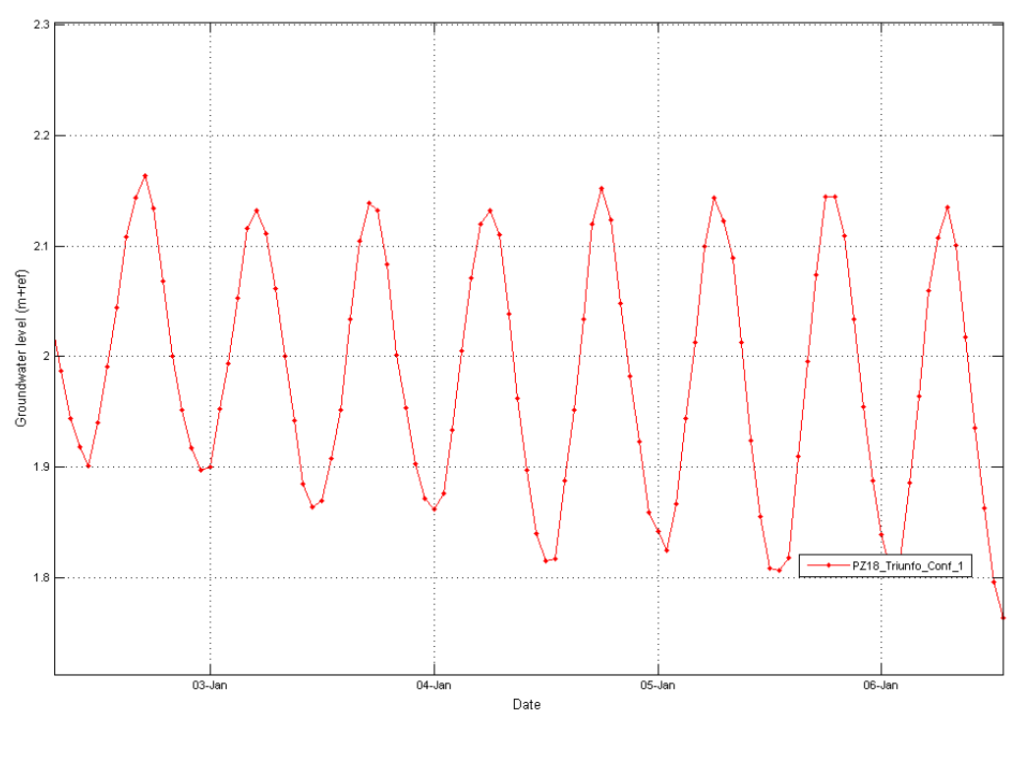
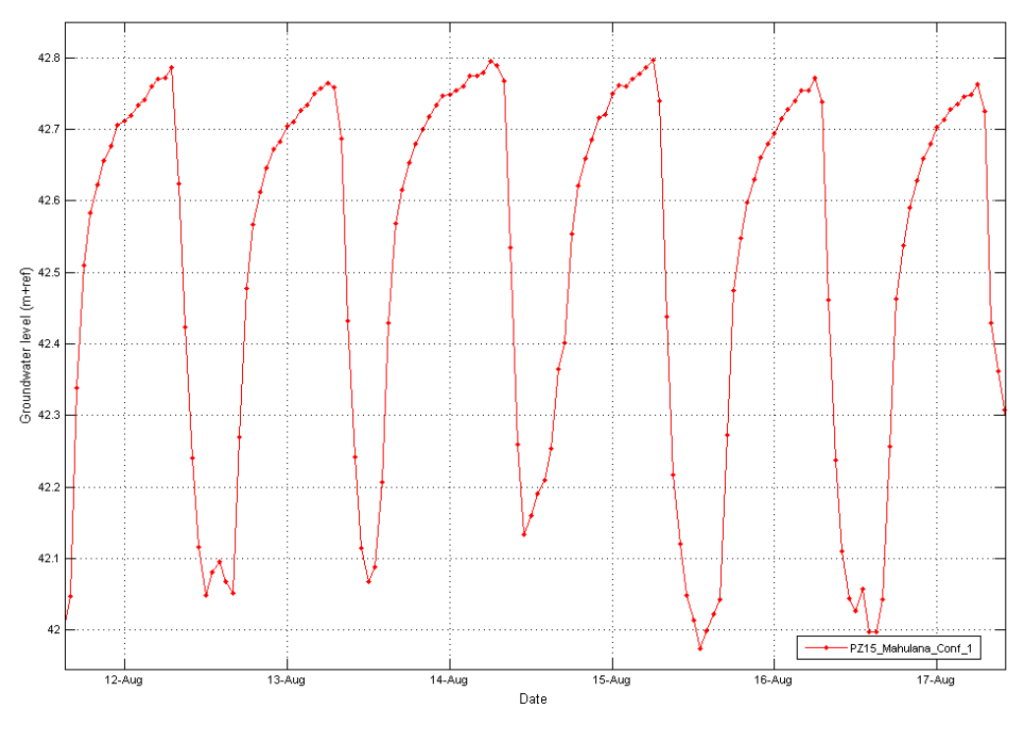
Hereunder in the left graph fluctuations in groundwater level appear twice a day. In this case, it means, the groundwater level is influenced by the tide. The right graph shows a groundwater decline at approximately 7 AM, lasting till 12 PM (only once a day). Which suggests that it’s caused by an "on-off" groundwater extraction. In addition, the water level never becomes a flat line (groundwater level at rest).

Share this article

Improved management in the relation with water users

In 2020 all ARA’s work on improving their water users relation management, by adopting the system SIRHSenior technician Lizete Dias of ARA Sul has experienced the system for two years:“Using this system, we achieved an increase of the number of licences, and consequently a rise of invoices for the use of water -and thus the budget of the institution”.

Licence management system

In 2017, iCartoa Spanish consultancy firm and partner of Blue Deal developed the ARAs Water Licence Management System (SIRH: Utentes). SIRH is not only a database, but also a tool to improve the work processes of all the departments of ARAs that are involved in the management of information on users.

Management improvements

ARA-Sul has been using this system for two years now. Lizete Dias:“SIRH has strengthened the management capacity of the departments of ARA-Sul and the internal information flow.“ In 2020, the Blue Deal project is funding the introduction of the system at ARA-Centro and ARA Centro-Norte. Furthermore, all ARAs will be getting workshops and training on the system. ARA Sul will realize system improvements to increase work efficiency.

Information on the use of water

With SIRH also information on the use of water in space and time becomes available, which is important. Because, as Lizete Dias states: “knowledge about water demand and resource availability is the key to improve access of people and enterprises to water”.

Share this article