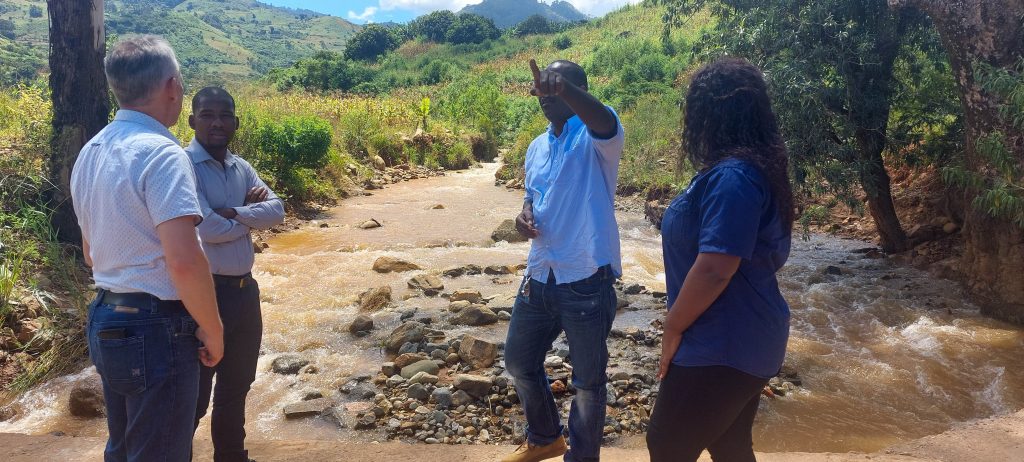
A delegation from the Blue Deal Program Office in The Hague and Dutch Water Authorities (DWA) visited Mozambique last November. The team, comprising Marieke van Nood (Blue Deal Programme Director), Martin Bos (Blue Deal Mozambique Partnership Director), Jan den Besten (Hunze en Aas), and Ytzen Faber (Wetterskip Fryslan), went to Beira to see how working with the Autonomous Sanitation Service of Beira (SASB) was going and to take part in the REMCO Conference, where important discussions about transboundary water management took place.
Partnering with SASB for financial sustainability
A part of the mission in Beira focused on discussing the financial future of the SASB. The discussion covered a wide array of topics in this regard, such as the increase in operational costs as new infrastructure becomes operational, the strong push towards professionalisation through good governance and the establishment of a new regulatory framework. These are just a few of the actions that would lead SASB in becoming a sustainable company.
Decentralizing the sanitation chain
The Blue Deal, DWA, and SASB teams also looked at the really important issue of decentralised sanitation in Beira.
A survey done in May 2025 showed that 65% of sludge lacks proper treatment.
To combat this environmental and health hazard, the partnership is launching a subsidy pilot project (by the FACE Association). The plan is to improve the sanitation chain by giving the city residents a reason to properly empty latrine pits and make sure the sludge is put in the right places, which are run by SASB.
Canal cleaning and infrastructure expansion
Flood prevention remains a top priority for the city of Beira, and currently 20-metre-wide canals are being constructed to improve the city's drainage.
At the SASB premises, the delegation planned the yearly drainage canal cleaning operation. The Blue Deal has been providing support to SASB (and FACE) on this matter for a few years and will continue to do so.
During the visit in November, the team explored alternative solutions to combat the rapid regrowth of vegetation, including the possibilities of using a mowing boat for the maintenance of the (new) retention basins and possibly also for the wider canals.


REMCO 2025
The mission concluded in Maputo with the REMCO 2025 conference, held from November 3 to 7.
As is customary, this year's conference – hosted by ARA Sul,IP and supported by three Blue Deal partnerships (Mozambique, South Africa and Eswatini) – focused on transboundary water management cooperation between these three countries.
Approximately 200 attendees were present, including representatives from the Blue Deal Office at Hague and Blue Deal delegations from Ethiopia, Mozambique, Eswatini, South Africa, Germany and partner organisations in the field of water management.
The Mozambican partnership was represented at the event by the aforementioned DWA representatives and Marijke Jaarsma (Waterschap Vallei en Veluwe), who moderated two sessions: one on digital cooperation among riparian states and one on the Blue Deal programme and African partnerships.
The conference concluded with a field visit, during which participants had the opportunity to learn more about the efforts of REPENSAR, an organisation developing several environmental conservation actions in the Maputo Basin.


***
The mission effectively connected operational improvements on the ground in Beira with high-level strategic discussions in Maputo.
The visit to Beira and Maputo provided a valuable opportunity for key personnel to meet in person and share their wide-ranging experiences. From the programme director to representatives from the Blue Deal partnerships and other entities, both cities were viewed as places offering valuable and memorable experience.